

The Field That Isn’t There
Notes from a morning in Washington with Ukrainian soldiers and veterans

Somewhere behind the front line in Ukraine there is a stretch of ground that looks, from above, like nothing at all. Grass, scrub, tire tracks, the same field a satellite photographed months ago. It is a photograph. Ukrainian medics pulled the imagery from mapping data, paid a print shop out of their own pockets to reproduce it on an enormous banner, and stretched it over their casualty stabilization point. Russian drones cross it every day and see a field. Beneath it, medics work on the wounded.
Nobody issued that banner. No procurement office approved it. The medic who told me the story this morning, over breakfast at a restaurant on 14th Street, said it plainly: “It’s not the army. We have to deal with it and find some solution.”
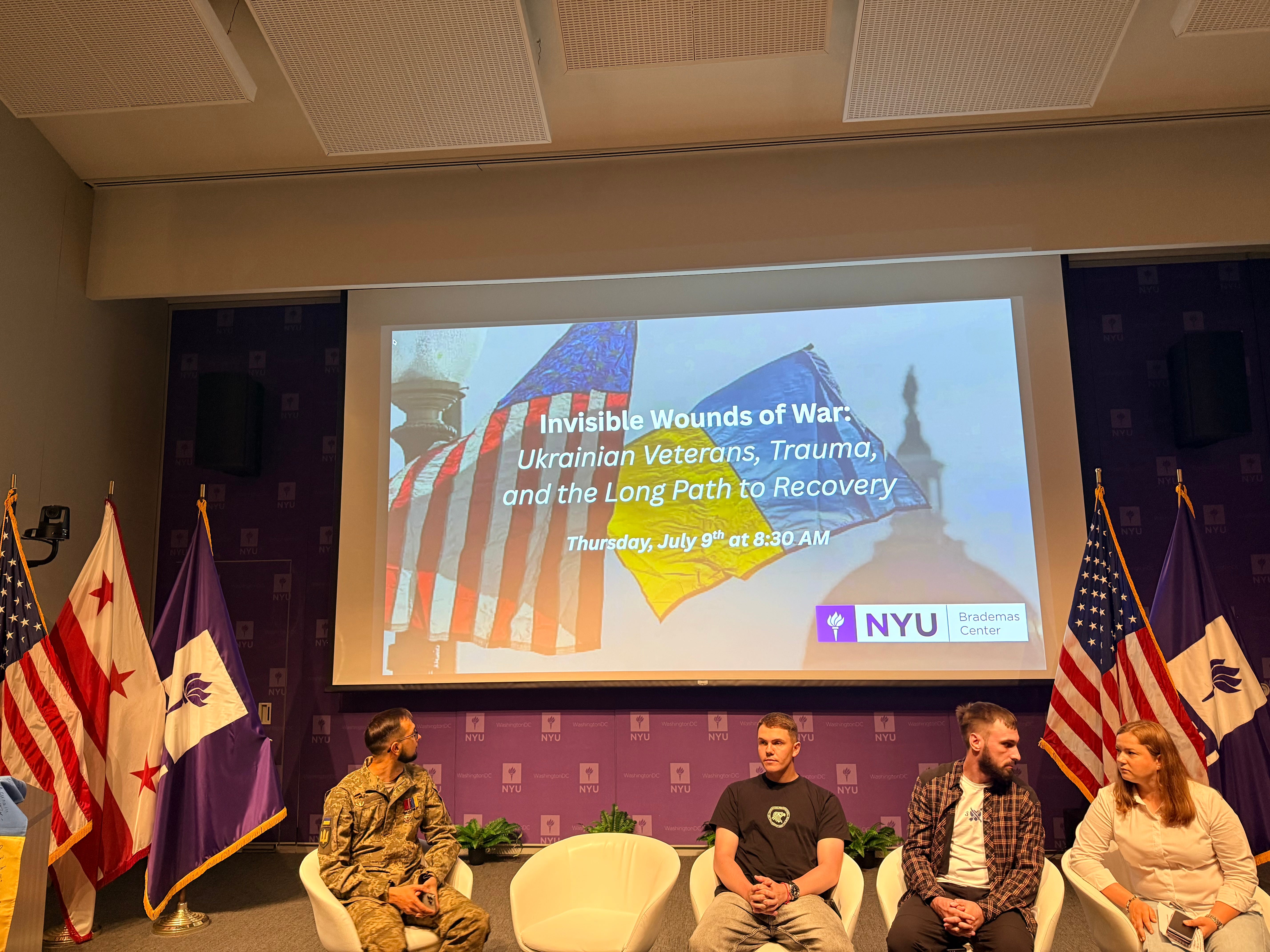
He was one of a small group of Ukrainian soldiers and veterans brought to Washington by former Congressman David Bonior for a conference at NYU’s Washington campus titled “Invisible Wounds of the War.” I spent the morning with them, first at breakfast and then in the auditorium, and I want to set down what they said while it is still fresh in my memory.
The Queen of War has a Rival
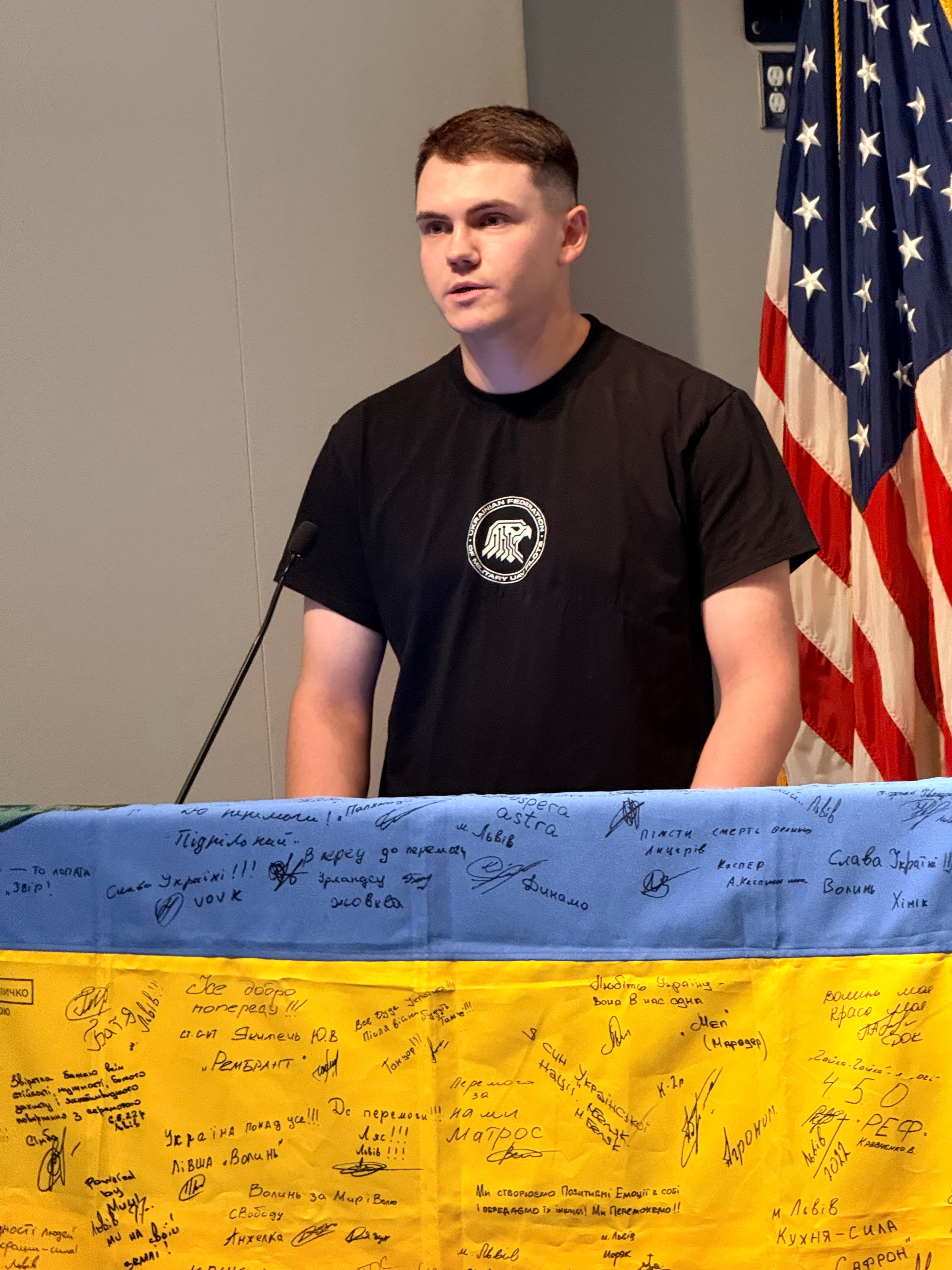
Pavlo is twenty-six. He joined the Ukrainian Marines at twenty-one, spent a year and a half as an assault infantryman with the 39th Brigade out of Odesa, then retrained as a drone pilot. He now teaches FPV drone warfare at his brigade’s school and helped found a national federation of military UAV pilots. He still believes the infantry is the queen of war. It starts every war and ends every war. He no longer believes she rules the battlefield alone.
The numbers he carries explain why. An FPV drone costs $700 to $1,500 and kills tanks worth millions. On the front line today, roughly 70 percent of destroyed targets are killed by drones. Artillery has fallen to second place. In 2022, Russian guns would only open up on a group of ten men. Today a single soldier walking in the open is worth a drone, and both armies have responded by digging. In some sectors the positions run so deep that the veterans at the table reached for two comparisons at once: the trenches of World War I and the tunnels of Vietnam.
The Physics Nobody Talks About
Ask an American about Ukrainian drones and you will hear about fiber optic cable, the jam-proof tether that supposedly rules the front. Pavlo waves most of that away. A coil carrying twenty-five kilometers of fiber weighs nearly three kilograms. Add the battery and the warhead and the drone lifts off at more than five and a half kilograms, trailing a thread one quarter the width of a human hair that snaps if the pilot flies carelessly. More than 70 percent of strikes still fly on ordinary radio links. A bigger battery does not buy more range; the added weight cancels the added capacity. He compares a well-run FPV crew to a mortar team that can choose its target, its approach angle, and its exact point of impact, guided onto the mark by a separate reconnaissance drone with a high-definition camera. Most of the warheads are homemade: plastic explosive, shrapnel, whatever the mission calls for.
Two of the men who flew beside him are dead. One had left the drones for the assault teams, wanting to do something more direct. Pavlo talks about luck the way only a man who has spent a great deal of it talks: “Luck is a type of fluid. It has a tendency to run out.”
I thought about my own daughter, an Army captain in an artillery brigade in Germany. After we came back from Ukraine last September, I told her to pay attention to this rapidly changing environment, where autonomous drones go deep behind the lines. In the event of a wider European war, she is their target. Nobody at the table disagreed.
Five Minutes, then Twenty Kilometers
The medic with the banner has been at this since 2014, and he corrected the room’s calendar early: the war began in 2014, the full-scale invasion in 2022. In the first year of the big war he could still drive to the line, load the wounded, and get out. The first ranging shot bought him a few minutes of grace. Reconnaissance drones ended that. Strike drones pushed the medics back five kilometers, then ten. Today he cannot come closer than twenty. Russian glide bombs, 250 to 1,000 kilograms, sail thirty to forty kilometers and reach even the rear medical points. Every vehicle he has run carries shrapnel scars from them.
He told one story I will not forget. Winter. Two soldiers down at a wire position ten kilometers out, presumed dead. At dusk a thermal drone picked up warmth where the bodies lay. Armor was too visible to send. So one man drove an unarmored buggy flat out across ten kilometers of contested ground, strapped both soldiers to the back, and drove home. One was dead. The other lived, with wounds that by every expectation should have killed him.
The arithmetic of evacuation governs everything, including relief. Units cannot rotate out when nothing can move. The longest front-line stint the medic witnessed was sixty days. Seven days under constant bombardment, he said, leaves a man praising the day he walks out.
He was wounded himself. Artillery, a shattered pelvis, doctors unwilling to promise he would walk. From the hospital bed he enrolled in a master’s program at the Ukrainian Catholic University. He now runs the university’s Kyiv office, building programs to train medics, army medical managers, and the social workers who will meet the veterans coming home.
Two Million
Ukraine expects roughly two million veterans in a population of about twenty-five million. In Ukraine, when one person joins the army the whole family serves. A wife cannot sleep until the daily message arrives that her husband is alive. And the wounds reach far past the uniforms. Kyiv absorbs missile attacks every weekend now. On the last one, Russia fired hypersonic missiles costing ten million dollars apiece into apartment blocks and a tram depot, more than one hundred million dollars spent in a single weekend against a city hundreds of kilometers from the front. One of the veterans scrolled through the photographs at breakfast: a burned tram yard, forty-two trams, a residential building completely destroyed.
America built its modern veteran support system only after Vietnam, driven by the suicides that followed the homecoming. But Ukraine is trying to build its own in the middle of the war.
The Auditor
One of the panelists was twenty-five when the invasion came: a PhD student, a senior auditor at PricewaterhouseCoopers, a promotion scheduled for summer and a wedding on the calendar. He fought for a year and a half, through the counterattacks that liberated occupied towns, and came home in 2023 unsure who he was. Twenty-three of his closest friends did not come home at all.
He wrote a book and made his dead friends its heroes. He could not bring them back to this world, so he gave them another one. He and his wife founded a small veterans’ publishing house. Then the Ukrainian Catholic University asked him to lead its Office of Veterans and Their Families, and he accepted, because he had felt the way back himself and thought he could show it to others. The office offers medical, legal, psychological, and spiritual support, with a goal of reaching ten thousand veterans by 2030. When it opened fifty seats in one training program, eight hundred veterans applied.
He quoted one of his veteran students on what it is like to sit in a classroom again: “They were all afraid of deadlines. Just yesterday I was afraid I would not live to see them.”
The Mountain
The last veteran we heard from today built something inside the 126th Brigade that he calls the service of care. It began for him in 2016, when a soldier died in his arms on a combat mission, and grew after 2022, when he watched wounded men and the families of the fallen left alone with their pain and the paperwork. He and his wife Larysa started visiting hospitals with supplies for the worst days. They count some five thousand soldiers supported since.
The number he is proudest of is smaller. It is the wounded men who return to duty a little changed, planning again, alive to a future. Few people believed in his mountain project. He gathered wounded soldiers, some of them amputees, and led them up the highest peak in Ukraine, where they planted a flag on the summit. Picture it, he told the room: a man who left a limb on the battlefield, standing on top of a mountain.
He went looking for partners in Europe and found people who had stopped watching Ukraine long ago. Then he found David Bonior’s organization, and he came to Washington to find more of us.
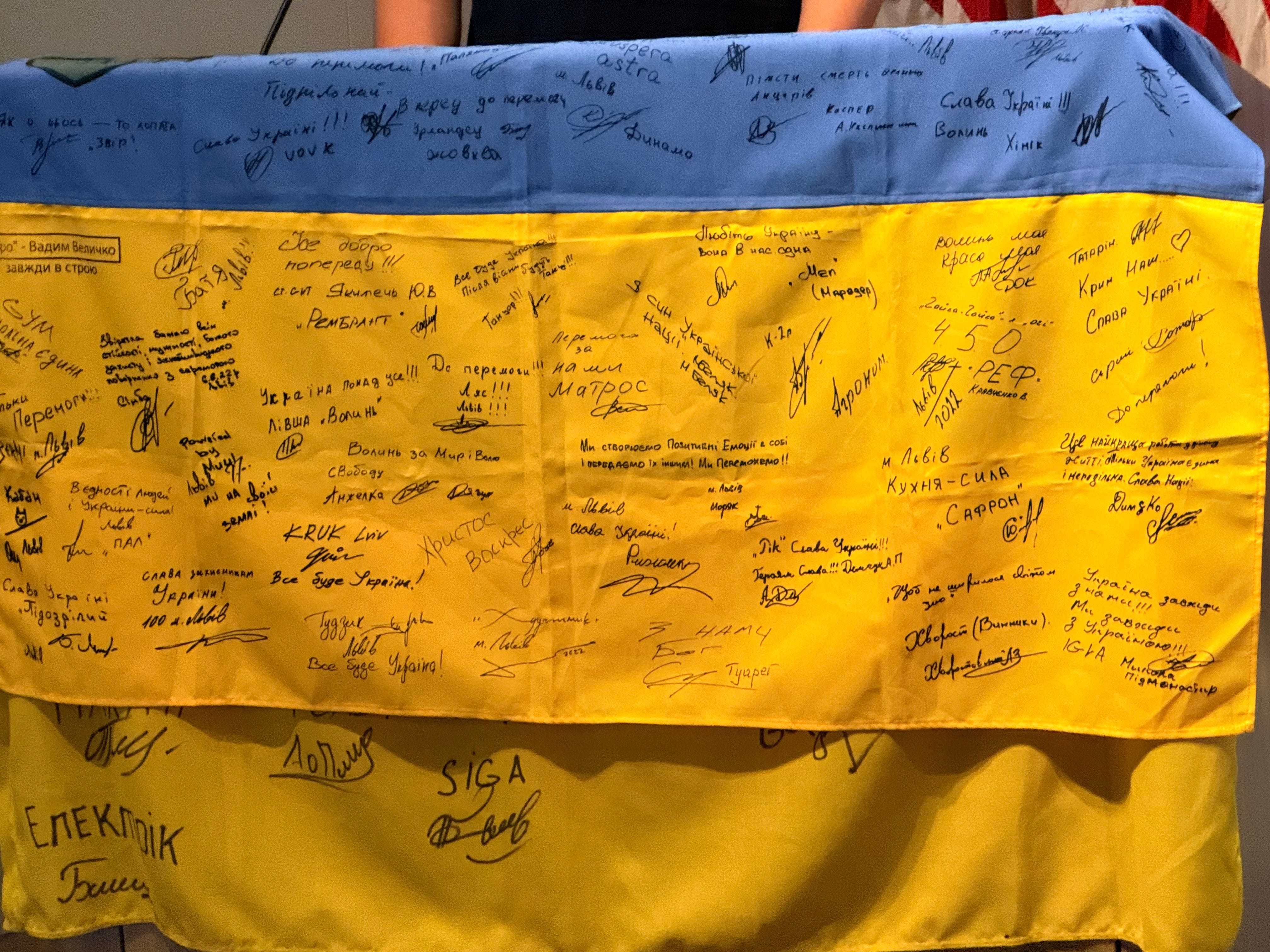
The Flag
The auditor ended his remarks with our own revolution. Two hundred fifty years ago, he reminded us, a small country defeated the greatest empire on earth, and the world learned what freedom means. Today another small country stands against the largest empire of this century. He is certain how it ends. The writing, he said, is on the wall for Moscow.
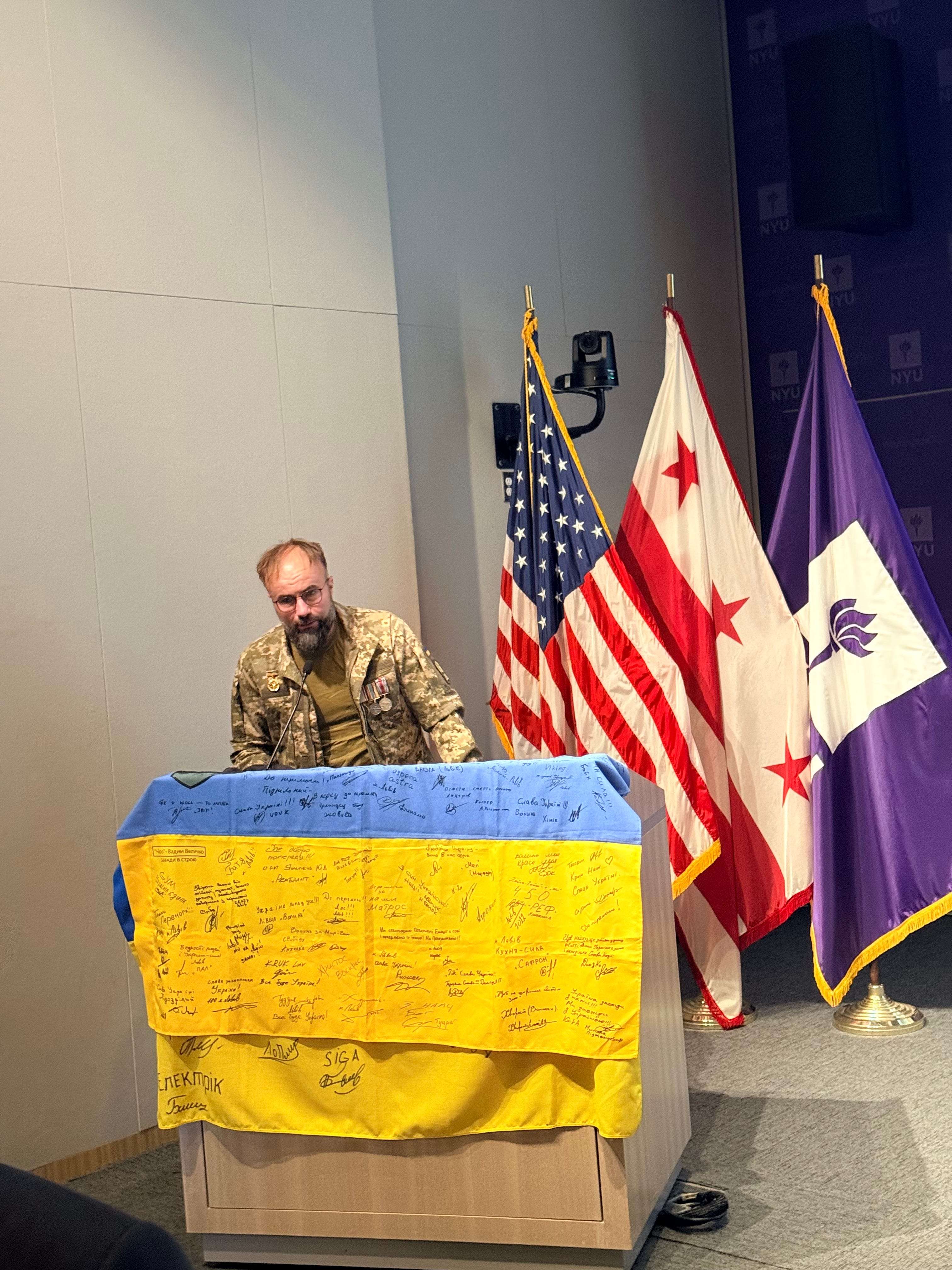
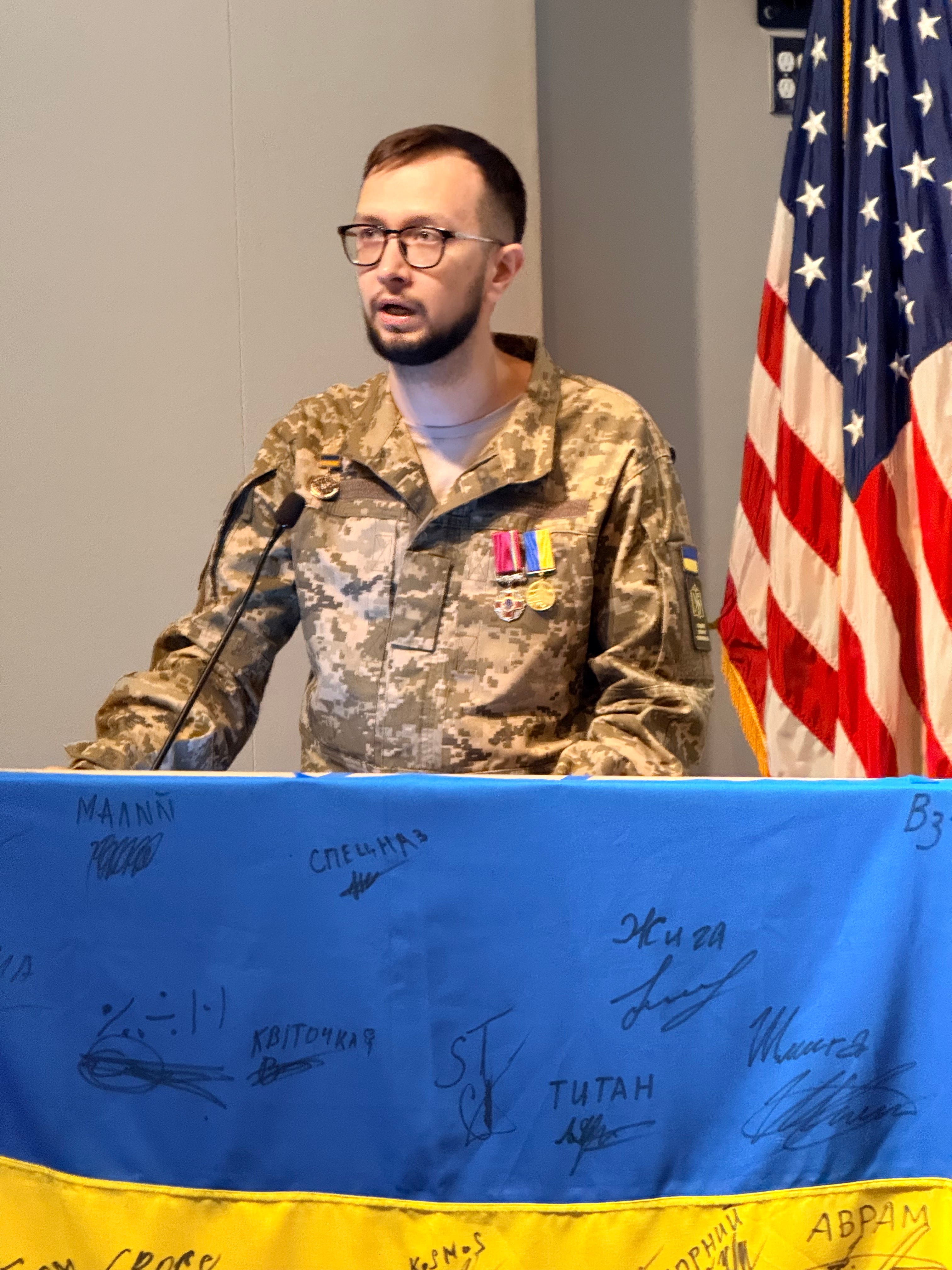
He had brought something with him. A Ukrainian flag, covered edge to edge in handwritten signatures, the names of the men and women who helped him survive. Many of the people who signed it are dead. He carried it anyway, across an ocean, into a room full of strangers in a capital far from his war, so that someone would read the names.
—John
Thank you John for sharing with us these insights. I feel for the Ukranians. I pray that War end and they prevail.